Choosing the right Medical Simulation Equipment in 2026 requires more than comparing prices and product photos. Training centers must match each device to learning objectives, learner experience, clinical specialty, and available space. A basic airway trainer may support initial technique practice, while a high-fidelity patient simulator can reproduce chest movement, changing vital signs, and medication responses. The difference matters.
This buying guide examines practical factors that affect daily training. It considers anatomical realism, software usability, replacement parts, cleaning procedures, warranty coverage, instructor controls, and integration with assessment systems. Experienced educators and biomedical technicians often notice details that brochures overlook. Can one instructor reset the simulator quickly? Are the sensors accurate after repeated sessions? Will local technicians support repairs?
Small details matter.
Reliable purchasing also requires evidence. Buyers should review manufacturer documentation, independent evaluations, user feedback, and applicable local safety requirements before committing funds. Compliance markings can support due diligence, but they do not replace institutional review or proper staff training. A realistic simulator is valuable only when instructors can use it consistently and learners receive meaningful feedback.
This guide is not a perfect formula. Budgets, curricula, and clinical priorities differ widely, and some technologies may become outdated sooner than expected. A careful buyer should question impressive demonstrations, test representative scenarios, and calculate long-term ownership costs. The strongest decision balances realism with durability, instructional value, service access, and measurable learning outcomes. That balance protects investment and keeps simulation focused on safer patient care.
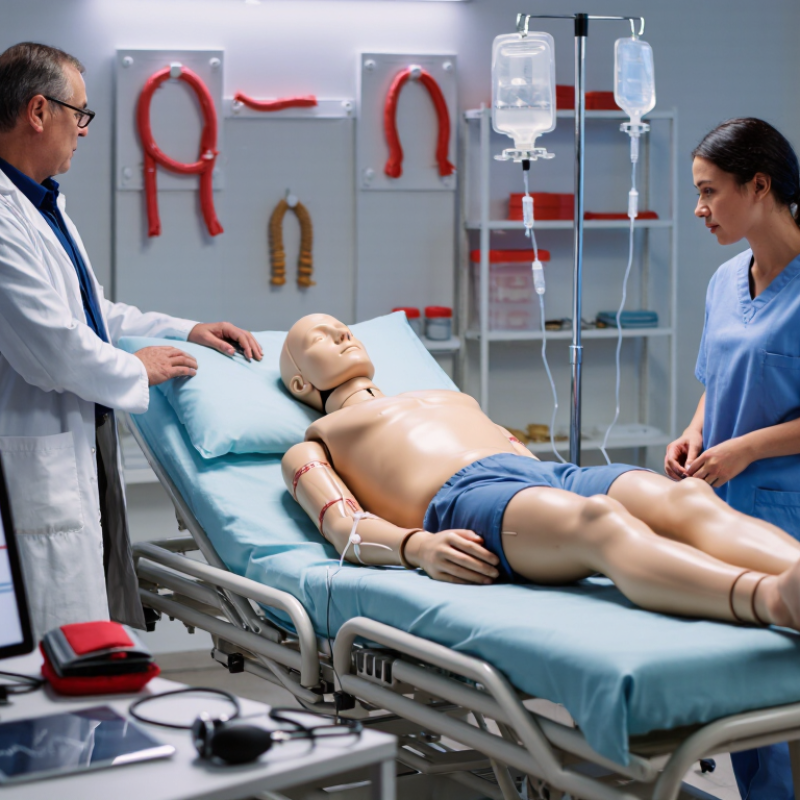
Medical simulation equipment recreates clinical conditions without exposing patients to training risks. It includes task trainers, full-body manikins, ultrasound phantoms, monitoring displays, airway devices, and virtual reality systems.
The scope now extends beyond emergency care. Hospitals use simulation for anesthesia, surgery, obstetrics, nursing, rehabilitation, and communication training.
A realistic setup may include a bleeding control pad, changing vital signs, and a defibrillator trainer beside the bed.
Equipment selection should follow learning objectives, not visual sophistication. The 2024 INACSL Healthcare Simulation Standards emphasize measurable outcomes, structured debriefing, psychological safety, and consistent assessment.
A high-fidelity manikin cannot repair weak instruction. That is easy to forget.
In practice, educators should check skin durability, replacement-part costs, software access, cleaning procedures, and instructor workload. A device that needs thirty minutes of setup may reduce actual practice time.
The World Health Organization’s Global Patient Safety Report 2024 states that approximately one in ten patients experiences harm during healthcare, with more than half considered preventable.
Simulation supports safer preparation by allowing repeated practice before clinical exposure. It can test medication checks, handovers, escalation decisions, and rare emergencies.
The 2011 JAMA systematic review examined 609 simulation-based education studies and found strong benefits for knowledge, skills, and learner behaviors.
Yet transfer to real care is not automatic. Buyers should request evidence of assessment validity, maintenance support, and documented improvements in local performance.
Bluntly, impressive equipment can still produce shallow training.
2026 Best Medical Simulation Equipment Buying Guide
Core equipment categories serve different educational purposes, so selection should begin with learning objectives, not impressive features. Task trainers support repeated practice of focused skills, such as venipuncture, airway insertion, wound care, and catheter placement. Their replaceable parts help learners repeat hand movements without patient risk. They are practical for early training, but they cannot reproduce the pressure of a deteriorating patient.
Full-body patient simulators add physiologic responses, voice interaction, vital-sign changes, and emergency scenarios. Learners can assess breathing, recognize shock, administer treatment, and communicate with a team. Instructors should verify that displayed responses match current clinical guidance. A realistic pulse is not enough. Poorly designed scenarios may teach confident mistakes.
Virtual simulation and screen-based platforms provide accessible practice for triage, decision-making, and documentation. They work well when learners need rapid feedback and multiple case variations. Procedural models remain valuable for tactile skills, especially when combined with ultrasound or monitoring equipment. Video capture systems support structured debriefing by showing communication gaps, delayed actions, or missed assessment steps. Debriefing matters most. Without skilled facilitation, recorded performance can become criticism instead of learning. Equipment also requires routine cleaning, calibration, software updates, and faculty training. A neglected simulator quickly becomes an unreliable teacher. One limitation deserves attention: advanced technology can distract from simple clinical reasoning. Teams should test each system with real instructors and representative learners before purchase, then review whether it changes performance in practice.
| Equipment Category | Typical Equipment | Core Educational Function | Key Capabilities to Evaluate | Recommended Learners | Common Training Applications | Assessment Evidence |
|---|---|---|---|---|---|---|
| Patient Care Manikins | Full-body adult, pediatric, and infant manikins with anatomical landmarks | Develops systematic patient assessment, clinical decision-making, communication, and hands-on procedural competence in a controlled environment. | Airway access, chest movement, palpable pulses, blood-pressure measurement, physiological response, replaceable parts, and cleaning compatibility | Nursing, medical, paramedic, and allied-health learners | Primary assessment, emergency response, basic life support, and patient handling | Skills checklists, vital-sign accuracy, clinical reasoning, and teamwork behaviors |
| High-Fidelity Physiological Simulators | Computer-controlled adult or pediatric simulator with programmable vital signs | Recreates changing patient conditions so learners can practice assessment, prioritization, intervention, reassessment, and escalation of care. | ECG rhythms, respiratory sounds, speech, drug-response modeling, scenario authoring, event logging, and instructor control | Advanced nursing, medical, anesthesia, and critical-care learners | Sepsis, respiratory failure, cardiac events, trauma, and deterioration management | Time-to-intervention, adherence to protocols, diagnostic decisions, and patient outcomes |
| Task Trainers and Part-Task Models | Injection pads, venipuncture arms, urinary catheterization models, airway heads, and wound-care models | Provides repetitive practice of discrete psychomotor skills before learners perform them on patients or in complex scenarios. | Tissue realism, anatomical accuracy, fluid return, tactile feedback, replaceable skin, and easy setup | Beginners through experienced clinicians requiring competency maintenance | IV access, injections, catheterization, wound dressing, airway insertion, and suturing | Procedure sequence, infection-control technique, equipment handling, and successful completion |
| Ultrasound and Imaging Trainers | Ultrasound phantoms, vascular-access models, and image-based diagnostic simulators | Teaches image acquisition, anatomical recognition, probe manipulation, and procedure guidance without exposing patients to unnecessary risk. | Tissue-mimicking materials, realistic sonographic appearance, needle visualization, image library, and repeated-use durability | Medical, nursing, emergency, anesthesia, and radiology learners | Vascular access, focused assessment, regional anesthesia, and procedural imaging | Image quality, target identification, needle trajectory, and procedural success |
| Surgical and Minimally Invasive Trainers | Laparoscopic boxes, endoscopic trainers, arthroscopy models, and procedural tissue systems | Builds hand-eye coordination, instrument manipulation, tissue handling, and procedural workflow in minimally invasive techniques. | Instrument compatibility, adjustable difficulty, camera integration, force feedback, reusable components, and recording functions | Surgical residents, operating-room staff, and specialist trainees | Camera navigation, knot tying, suturing, dissection, and endoscopic orientation | Completion time, error count, instrument economy, tissue handling, and procedural accuracy |
| Obstetric and Neonatal Simulators | Childbirth manikins, maternal-fetal monitoring trainers, and newborn resuscitation models | Supports team-based management of normal birth, obstetric emergencies, neonatal stabilization, and timely escalation. | Fetal heart-rate patterns, birthing positions, postpartum bleeding, airway response, umbilical-cord handling, and scenario control | Midwifery, obstetric, nursing, pediatric, and emergency-care learners | Shoulder dystocia, postpartum hemorrhage, breech birth, neonatal resuscitation, and newborn assessment | Response time, task prioritization, communication, neonatal ventilation, and safety practices |
| Emergency and Trauma Simulation Equipment | Trauma manikins, bleeding-control trainers, extrication models, and emergency procedure kits | Develops rapid assessment, hemorrhage control, resuscitation, triage, and coordinated team response under time pressure. | Realistic bleeding control, airway and chest procedures, injury variation, transport compatibility, and rugged construction | Paramedics, emergency nurses, physicians, military-medical, and disaster-response teams | Mass-casualty triage, bleeding control, chest decompression, splinting, and transport | Triage accuracy, hemorrhage-control time, protocol compliance, and team coordination |
| CPR and Resuscitation Trainers | Adult, child, and infant CPR manikins with feedback-enabled compression systems | Improves high-quality chest compressions, ventilation, defibrillation workflow, and coordinated resuscitation performance. | Compression depth and rate feedback, recoil measurement, ventilation detection, defibrillator compatibility, and performance reports | All healthcare students, clinicians, first responders, and community trainees | Basic life support, advanced life support, choking response, and resuscitation team drills | Compression quality, ventilation volume, interruption time, rhythm recognition, and role performance |
| Virtual Reality and Augmented Reality Systems | Head-mounted displays, interactive clinical modules, and mixed-reality procedural platforms | Enables scalable practice of clinical reasoning, spatial anatomy, procedures, and rare or high-risk scenarios in immersive environments. | Tracking accuracy, accessible interface, scenario branching, haptic options, learning analytics, and offline capability | Students, residents, continuing-education learners, and interprofessional teams | Anatomy, medication safety, surgery orientation, emergency decision-making, and procedural rehearsal | Decision pathways, task accuracy, completion time, error frequency, and knowledge retention |
| Clinical Skills Recording and Debriefing Systems | Multi-camera recording, screen capture, audio systems, and simulation-center debriefing software | Strengthens reflective learning by allowing instructors and learners to review clinical actions, communication, and decision-making. | Synchronized audio and video, secure storage, annotation, playback control, privacy management, and exportable reports | All healthcare education levels and faculty development programs | Scenario debriefing, objective structured clinical examinations, coaching, and quality improvement | Observed behaviors, communication quality, critical incidents, reflective statements, and action plans |
Note: Equipment selection should be matched to curriculum outcomes, learner level, available faculty expertise, room infrastructure, cleaning requirements, maintenance support, and total cost of ownership.
Facility planning should begin with risk, not product catalogs. The World Health Organization’s Global Patient Safety Report 2024 estimates that one in ten patients experiences harm in healthcare. More than half of these incidents are considered preventable. That evidence supports simulation, but it does not justify buying the most complex manikin. Map local incidents first: medication errors, airway emergencies, falls, or delayed escalation. Then record room size, storage, cleaning capacity, educator time, and network access. A mobile task trainer may outperform a full-body system in a crowded skills lab. Measure the gap.
one in ten patients
experiences harm in healthcare
Tips:
Create three learner profiles: novice, progressing, and advanced. Novices need visible anatomy, repeatable practice, and immediate coaching. Intermediate learners need timed scenarios and documentation. Advanced teams need uncertainty, competing priorities, and communication challenges. Match every feature to a learning objective. If the objective is sterile dressing technique, advanced conversation software may add little value. The 2024 Healthcare Simulation Standards of Best Practice emphasize objectives, prebriefing, facilitation, and debriefing, not equipment alone. Keep an equipment-to-outcome matrix. It exposes weak assumptions.
50%
of clinical hours could be replaced under strong implementation and evaluation
Training goals should also shape fidelity. The NCSBN National Simulation Study found that simulation could replace up to 50% of clinical hours under strong implementation and evaluation. That figure is not a universal quota. It depends on faculty preparation, learner assessment, and clinical context. Ask suppliers for uptime records, repair response times, consumable costs, and accessibility testing. Pilot two scenarios with real instructors. Watch for setup delays. Our first specification may still be wrong. Revise it after learner feedback, failed transfers, and one unplanned technical problem.
2026 Best Medical Simulation Equipment Buying Guide
Technical, Safety, and Compatibility Criteria for Equipment Selection
Choosing medical simulation equipment requires more than comparing prices or visual realism. Start with the training objective. A task trainer for wound care needs different sensors than a full-body manikin for emergency response. Check measurement accuracy, response time, software stability, and data export options. Confirm whether the system supports common file formats and integrates with your learning platform. Proprietary connections may limit future upgrades.
Safety should be tested before purchase. Inspect cables, power supplies, heated surfaces, moving joints, and small detachable parts. Ask for electrical safety documents, cleaning instructions, and risk-control procedures. Materials should tolerate repeated disinfection without cracking or becoming sticky. Instructors also need clear emergency stop procedures. I have seen teams focus on clinical realism and overlook storage conditions. That mistake can shorten equipment life.
Tips: Build a hands-on evaluation checklist. Run a sample scenario with actual instructors and learners. Test setup time, reset time, noise, and software recovery after a failed connection. Confirm compatibility with local power requirements, network security rules, and existing audiovisual systems. Keep written records of every limitation. A checklist is useful, but it can still miss awkward cable placement or confusing menus. Treat user feedback as technical evidence, not a complaint.
Use this weighted procurement model to compare medical simulation equipment. Safety and risk management receive the highest weighting because medical electrical equipment should be assessed against applicable requirements such as IEC 60601-1, IEC 60601-1-2, ISO 14971, and IEC 62366-1.
How to use the chart: Score each product against the six criteria, then multiply each score by the corresponding weight. Confirm electrical safety, electromagnetic compatibility, usability, risk controls, software lifecycle practices, and cybersecurity requirements before purchase. Compatibility should include connections, data formats, network requirements, accessories, and integration with existing training systems.
In 2026, medical simulation equipment purchasing requires more than comparing prices.
Budget plans should include trainers, replacement parts, software access, room modifications, staff training, and annual maintenance. An apparently affordable manikin can become expensive when compatible accessories or technical support are excluded. Set a three-year ownership estimate. Ask suppliers for itemized quotations, warranty terms, delivery schedules, cybersecurity documentation, and repair response times. Clinical educators, procurement officers, and biomedical engineers should review the same scoring sheet. That shared review reduces personal bias and exposes missing requirements.
Implementation works best when equipment matches real teaching routines.
Before delivery, measure doorways, electrical capacity, network coverage, storage space, and cleaning facilities. Create a pilot session with instructors, technicians, and learners. Observe setup time, operating errors, audio clarity, realism, and reset demands. Document every issue. Early testing often reveals that a technically advanced system is too slow for a busy classroom. Training should include hands-on practice, quick-reference procedures, and a clear escalation path for faults. Do not assume confidence after one demonstration.
Lifecycle management begins on the first day.
Assign an owner for calibration records, software updates, cleaning schedules, accessories, and incident logs. Review usage data each quarter. Low utilization may signal poor scheduling, weak faculty adoption, or unnecessary complexity. However, usage numbers alone can mislead. A rarely used trainer may support high-risk scenarios that deserve careful availability. Plan replacement before failures disrupt courses, and retain a realistic contingency fund. Our planning can be imperfect; optimistic repair assumptions have caused delays. Revisit the budget annually, using learner feedback, maintenance evidence, and documented clinical priorities.
It recreates clinical conditions without exposing patients to training risks. Examples include task trainers, full-body manikins, ultrasound phantoms, and virtual reality systems.
Simulation supports emergency care, anesthesia, surgery, obstetrics, nursing, rehabilitation, and communication training. It can also rehearse handovers and escalation decisions.
Start with measurable learning objectives, not visual sophistication. A wound-care trainer needs different sensors from an emergency-response manikin. Realistic appearance is not enough.
A bedside setup may include a bleeding-control pad, changing vital signs, and a defibrillator trainer. These details create focused practice conditions.
Check measurement accuracy, response time, software stability, and data export options. Confirm compatible file formats and learning-platform integration. Restricted connections may limit future upgrades.
Inspect cables, power supplies, heated surfaces, moving joints, and detachable parts. Request electrical safety documents and clear emergency-stop procedures. Cleaning materials must withstand repeated disinfection.
A device requiring thirty minutes of setup can reduce practice time. Test storage conditions, reset time, noise, and software recovery. Small inconveniences become repeated problems.
No. Transfer to real care is not automatic. Use structured debriefing, psychological safety, and consistent assessment. Evidence of local improvement matters more than impressive equipment. We may still overestimate realism.
This 2026 buying guide explains how Medical Simulation Equipment supports healthcare education by creating realistic, controlled environments for practicing clinical knowledge, technical skills, communication, teamwork, and decision-making. It introduces major equipment categories, including patient simulators, task trainers, virtual learning tools, audiovisual systems, and supporting accessories, while outlining the educational purpose of each category. The guide also shows how institutions can match equipment choices with facility capacity, learner experience, curriculum requirements, and specific training outcomes.
It further presents practical selection criteria, such as realism, durability, safety, ease of maintenance, data capabilities, accessibility, and compatibility with existing teaching spaces and technology. Readers will also find guidance on budgeting, comparing total ownership costs, planning procurement, preparing instructors and learners, and integrating equipment into daily programs. Finally, the guide emphasizes responsible implementation, regular maintenance, upgrades, evaluation, and lifecycle planning to ensure that investments remain useful, sustainable, and aligned with changing educational needs.

Fule